

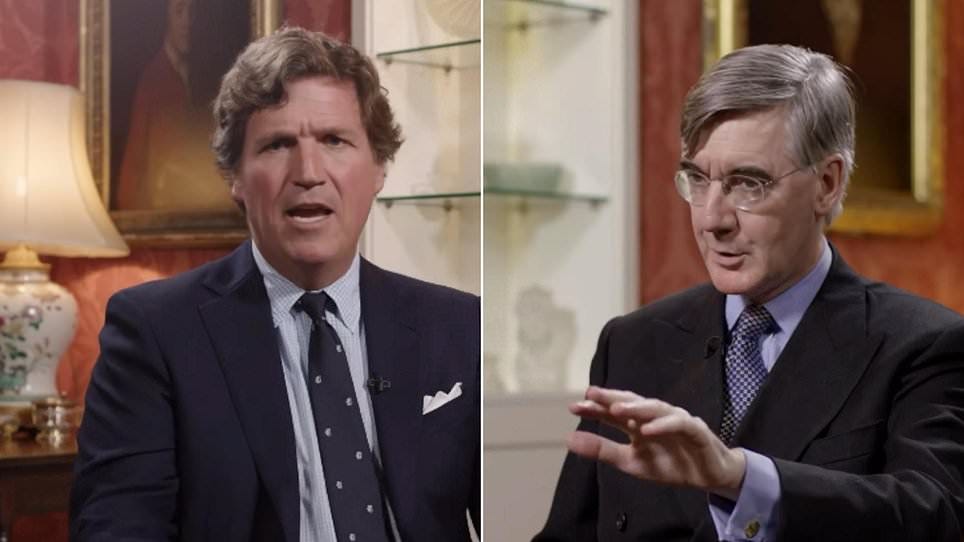
It has been salutary listening to liberals fawn over Britain’s ultimate rightwing nationalist toff, Jacob Rees-Mogg, claiming that in an interview at the weekend he “schooled” Tucker Carlson, the United States’ ultimate rightwing nationalist WASP.
LBC’s James O’Brien, a diehard Remainer, was giddy with excitement over the confrontation. Apparently the Eton-educated, Brexit-cheerleading peer made a fool of Carlson during their hour-long conversation.
But what exactly was Carlson schooled on?
Actually of the two, Rees-Mogg sounded by far the more extreme. Which, I admit, is saying something.
His reasoning was also riddled with contradictions and inconsistencies.
All of this is being intentionally obscured by the establishment media, in both its rightwing and liberal flavours. They want to focus instead on a brief section in which Carlson, a strict isolationist, expresses doubts about whether the UK had a national interest in fighting Nazi Germany.
If that sounds unhinged, wait till you hear what Rees-Mogg has to say in response.
1. Throughout the interview, Rees-Mogg struggles to articulate what meaningful threat he believes Russia poses to the UK. Nonetheless, he is certain that Britain needs to spend far more taxpayers’ money on arming the UK against that threat. He calls for even deeper austerity cuts, stripping out the last vestiges of social spending.
He, of course, wants that money redirected to western weapons industries that have a vested interest in continuing to provoke Russia, China and Iran into forever wars that enrich shareholders. Is it possible Lord Rees-Mogg may be just such a shareholder?
2. Astonishingly, Rees-Mogg maintains that it was “unquestionably” justified for the US to use an atomic bomb on the Japanese cities of Nagasaki and Hiroshima, murdering hundreds of thousands of civilians.
He rationalises his position, as many people do, by claiming that this horrifying act of mass murder helped to hasten the end of the Second World War and thereby, overall, saved lives – a view that a diminishing number of scholars still support.
It seems far more likely the explosion of two atomic bombs was intended as a decisive demonstration of US military might, at the moment it was formally taking on the mantle of empire from Britain, against an emerging rival in the shape of the Soviet Union.
Notice too that Rees-Mogg thinks it was legitimate for the US to mass-murder Japanese civilians in 1945 in its geopolitical interests: as a method to speed up the end of the Second World War. But he absolutely rejects Moscow’s right to use a nuclear bomb against Ukraine in its geopolitical interests. Instead he urges Nato to continue provoking Russia into greater militarism by helping Ukraine to bleed its neighbour on the battlefield.
Might Russia not reasonably think, employing Rees-Mogg’s logic, that the use of a nuclear missile would similarly hasten the end of the West’s proxy war in Ukraine and thereby, overall, save lives?
3. Rees-Mogg and Carlson clash over the issue of murdering children and using nuclear bombs against civilians. Rees-Mogg is in favour of massacring civilians in any situation he deems to be “total war”, a concept he appears unable to define, while Carlson is strictly against killing innocents.
But, it seems, Carlson is the extremist.
Notice here that Rees-Mogg’s argument implicitly launders recent rationalisations by western establishments for supporting Israel as it has carried out the genocidal slaughter of Palestinian children in Gaza.
4. Rees-Mogg is deeply opposed to placing restraints on the behaviour of the nation state. This is why, he says, he supports Nato – because it is what he calls a “voluntary” supra-national body. He contrasts Nato with other international institutions like the European Union and the International Criminal Court (ICC), both of which he seems to oppose. The ICC is the main international body for determining and upholding international law.
If you side with Rees-Mogg on this point, you effectively favour a return to the law of the jungle, where big states can beat up on small states. Which is strange because Rees-Mogg spends most of the interview being indignant that a nuclear-armed big state, Russia, has got away with invading a weaker neighbour, Ukraine.
5. Carlson points to an obvious contradiction in Rees-Mogg’s position. The British peer declares sovereignty to be the supreme moral purpose of the nation state, but is then satisfied for the UK to serve as a US vassal state, obediently taking orders from Washington.
Carlson presents the UK as an occupied territory under the thumb of the US and its military since 1945. Anyone not in thrall to our establishment political and media class might suspect he has a point.
6. Carlson makes the reasonable observation that – despite Rees-Mogg endlessly justifying the killing fields in Ukraine on the basis that Ukrainian national sovereignty must be protected at all costs, even if it results in nuclear confrontation – the US is, in fact, no more interested in protecting Ukrainian national sovereignty than Russia is.
Both want it to see Ukraine turned into a vassal state: the US expressly to repurpose it as an offensive forward base for Nato on Russia’s doorstep; and Moscow to prevent just such a development and secure what it regards as its back yard (in the same way that Washington regards Central and Latin America as its back yard).
7. Carlson points out that the UK and Rees-Mogg’s support for intensifying the proxy war in Ukraine – supposedly as a deterrence against any supposed expansionist ambitions from Russia – makes little sense. Endlessly upping the military stakes for Russia in Ukraine, and helping Kyiv to take the war directly into Russian territory, is simply driving Moscow into using more force.
Russia has both hypersonic and nuclear weapons that can quickly defeat Kyiv if it chooses to use them. The West would have no meaningful response – apart from using its own nuclear weapons.
If Nato keeps pushing Moscow into a corner – and continues blocking any kind of negotiation that might lead towards a deal, as it has done from the outset of the invasion – Russia is likely to take the war to “another level”, as Rees-Mogg calls it.
The logic of the West’s position is ultimately towards nuclear confrontation. And there is something profoundly dishonest, as Carlson keeps pointing out in their interview, in refusing to acknowledge that fact. Nato is lighting a box of matches right next to a fuse connected to a nuclear bomb.
Carlson keeps pointing to this elephant in the room, while Rees-Mogg (and western liberals behind him) keep desperately trying to ignore it.
Although my posts are freely accessible, they are reader-supported. If you liked this one or any of the others, please consider sharing it with friends and making a donation to support my work. You can do so by becoming a paid Substack subscriber, via Paypal or my bank account, or alternatively by setting up a monthly direct debit mandate with GoCardless. A complete archive of my writings is available on my website. I’m on X, Facebook and Bluesky.
Interesting piece and thanks for that. But I would like to question the statement that Russia wants to secure Eastern Ukraine as being “what it regards as its back yard (in the same way that Washington regards Central and Latin America as its back yard)”. The two are not remotely equivalent. Culturally and governmentally, Ukraine (especially the eastern oblasts) has been a part of Russia for centuries until the collapse of the Soviet Union. Latin America however never owed itself or belonged in any way to the USA but has been subject since its inception to US hegemony and exploitation. And with the exception of the Cuban crisis, Russia has not exploited Latin America to pose a military threat to the US, whereas the US/ NATO have arguably used Ukraine to threaten Russia. Russia therefore does have some justification for concern about what is happening in its “back yard’” whereas the US, if the facts are truthfully laid out, is in tricky terrain trying to justify its dominance over central and South America.
They're arguing about which version of Anglophoney world imperium is most sensible. Both take as a given their own privileged place in this proper hierarchy based on the norms of power and domination. Of course western liberals are fine with this. As neolibs and neocons out of the Oxbridge and Ivy elites, they provide the intellectual justifications. Just as their predecessors did for colonization and racism.